
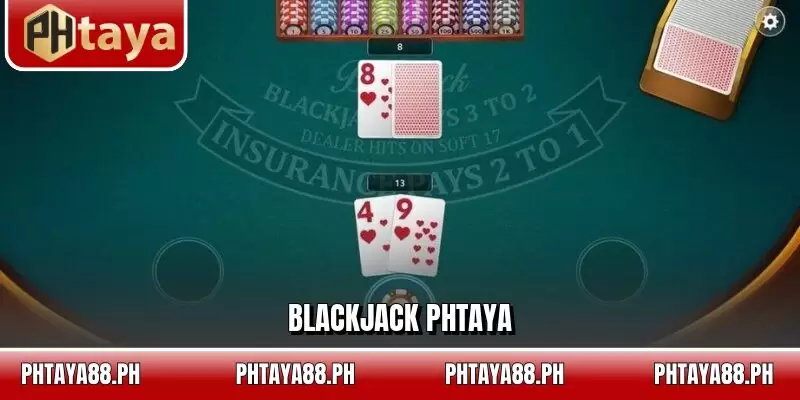
Blackjack PHTAYA offers the premier version of the world’s most popular casino banking game, standing apart due to its unique blend of chance and skill. At PHTAYA, players discover a game where making mathematically correct decisions can dramatically influence the outcome, rewarding intellectual engagement over mere luck.
What makes the blackjack PHTAYA gameplay unique?
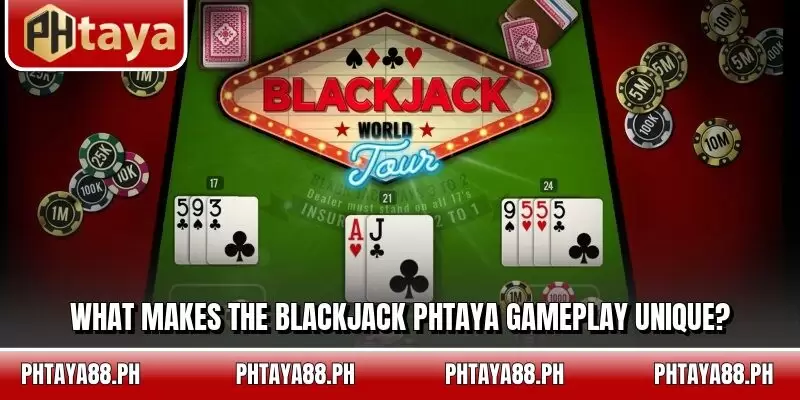
What makes the blackjack PHTAYA gameplay unique?
The enduring appeal of Blackjack PHTAYA lies in its exceptionally low house edge, often around 0.5%–1.0%, which can be reduced even further by players who strictly follow optimal strategy. This transforms Blackjack from a game of pure chance into one of measurable skill.
The actual house edge depends on table rules such as 3:2 payouts, S17 versus H17, and doubling or splitting options. PHTAYA features player-friendly rules, allowing disciplined strategists to achieve the strongest theoretical return and making mastery genuinely worthwhile.
Core rules and advanced actions in Blackjack PHTAYA

Core rules and advanced actions in Blackjack PHTAYA
Understanding the fundamental rules is the bedrock of play, but true competence in Blackjack PHTAYA requires mastering the full spectrum of advanced actions available to the player, which are designed to capitalize on favorable situations.
Every rule variation and action choice is a subtle adjustment to the game’s overall probability structure.
The objective and card values
The goal in Blackjack PHTAYA is to achieve a hand total closer to 21 than the dealer’s hand, without exceeding 21 (a bust).
- Number cards (2-10): Their face value.
- Face cards (J, Q, K): are counted as 10.
- Ace: Counts as 1 or 11, whichever is more advantageous to the hand. An Ace that can be counted as 11 without busting is a soft hand (e.g., A-6 is soft 17).
A natural Blackjack (an Ace and any 10-value card dealt as the first two cards) usually pays 3:2, providing the single best return in the game and instantly ending the hand with a favorable outcome.
Player options after the deal
Once the initial two cards are dealt, the player has several critical decisions to make, each carrying significant mathematical weight in Blackjack. Knowing when to deviate from a simple Hit or Stand choice is crucial for success.
- Hit: Acquire a further card to boost the score of your hand.
- Stand: Keep the current hand total and end the action for that round.
- Double Down: Double the original bet and receive exactly one more card, then automatically stand. This action is typically restricted to hands totaling 9, 10, or 11, and should be used aggressively when the dealer shows a weak upcard.
- Split: If the first two cards are a pair (e.g., two 8s), the player can split them into two separate hands by placing a second wager equal to the original bet. This allows the player to potentially win twice against the dealer.
- Surrender (where permitted): The player forfeits half the original bet and ends the hand immediately. This is only advisable in specific, mathematically dire situations (e.g., having 16 against a dealer’s 9, 10, or Ace).
Key rule variations at the Blackjack tables
The subtle nuances of table rules have a major impact on the player’s long-term return. Astute players at Blackjack PHTAYA will always seek out the most favorable rule sets available.
| Rule Variation | Player Impact | Optimal Table Choice |
| Blackjack Payout | 3:2 is significantly better than 6:5 | Always choose 3:2 tables. 6:5 increases the house edge by over 1.3%. |
| Dealer on Soft 17 (A-6) | Dealer Hits (H17) increases the house edge; Dealer Stands (S17) is better. | Prefer S17 tables when available at Blackjack. |
| Doubling After Split (DAS) | Allows players to double down on a hand created by splitting a pair. | DAS is a favorable rule and lowers the house edge. |
| Number of Decks | Fewer decks generally decrease the house edge slightly. | Single-deck or double-deck Blackjack offers marginally better odds. |
The difference between a 3:2 payout and a 6:5 payout is not trivial; it is the single largest factor in the house edge. For every 10 wagered, a 3:2 payout yields $15, while a 6:5 payout yields only $12. This alone makes selecting the correct table the first step toward sustained profitability in Blackjack.
Strategic pathways to dominating Blackjack PHTAYA
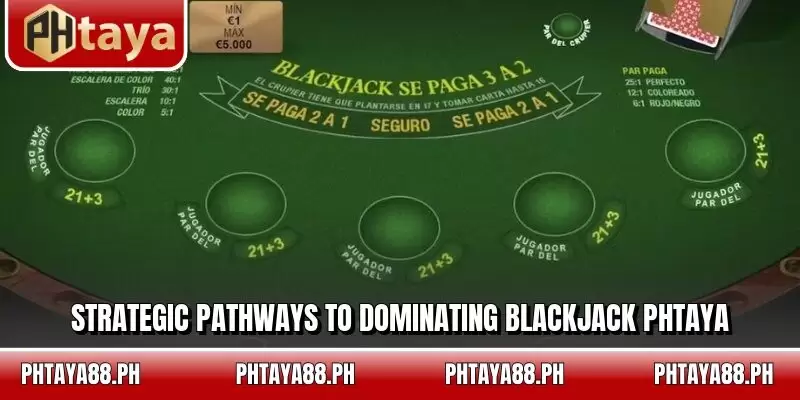
Strategic pathways to dominating Blackjack PHTAYA
Achieving the lowest house edge demands flawless execution of Basic Strategy, a mathematically proven guide for every hand against any dealer upcard. Mastery of risk management further supports success in high-stakes Blackjack PHTAYA.
This disciplined approach removes guesswork and ensures the highest possible long-term return under the given table rules.
Absolute mastery of the basic strategy
The Basic Strategy for Blackjack PHTAYA is a mandatory framework for minimizing the house edge, requiring players to memorize the correct action for every hand against each dealer upcard. It is mathematically proven and forms the foundation of all profitable play.
By exploiting dealer weaknesses on low cards and adjusting play against strong upcards, this strategy shifts the game’s economics in the player’s favor when applied consistently.
Strategic doubling down and splitting
Doubling down and splitting are the most powerful offensive tools available to the player in Blackjack, allowing them to increase their wager precisely when the odds are momentarily in their favor. Misusing these actions can be devastating, but applying them correctly is critical for reducing the house edge.
- Doubling Down: The basic strategy mandates doubling on specific hand totals (like 11 against a dealer’s 2-10, or 9 against a dealer’s 3-6) because the probability of receiving a 10-value card is highest. This maximizes profit when the dealer is weakest.
- Splitting: Always split Aces and 8s. Splitting Aces turns a weak 2 into two hands with a strong starting value of 11, giving a high chance of hitting 21. Splitting 8s turns a poor total of 16 into two manageable hands, avoiding the mathematically worst hand in Blackjack. Never split 10s or 5s, as the former is already a powerful total and the latter is better used as a Double Down opportunity.
Understanding bankroll management for variance control
Even with perfect Basic Strategy, Blackjack PHTAYA is still affected by short-term variance and inevitable losing streaks. Strong bankroll management is essential, with each bet limited to 1%–2% of the total bankroll.
This controlled sizing protects players from ruin, allowing the long-term edge to emerge. Chasing losses or betting emotionally destroys this advantage and reduces the game to pure chance.
Conclusion
Blackjack PHTAYA provides a compelling opportunity to engage in a casino game where discipline and mathematical strategy triumph over simple luck. By mastering the optimal Basic Strategy, carefully selecting tables with favorable rules, and rigidly managing your bankroll, you can drive the house edge to its lowest possible point.
 Golden And Silver Horn Summon Legendary Treasure Power
  Formosan Birds – Master The Sky And Claim Your Fortune
  Dragon Treasure – Master The Ocean And Dominate At PHTAYA
  Jaw-Dropping Strategies in Tiger Baccarat’s Clever Playbook
  Dragon Treasure – Master The Ocean And Dominate At PHTAYA
  Midnight Terror – Discover The Hidden Wealth In The Dark