

Baccarat PHTAYA presents the sophisticated card game that is renowned for its simple rules and some of the best statistical odds available in the entire casino. At PHTAYA, players embrace a game requiring no complex decisions during play, instead focusing their strategy entirely on intelligent bet selection and disciplined bankroll management.
The history and evolution of Baccarat PHTAYA
The history and evolution of Baccarat PHTAYA
The appeal of Baccarat PHTAYA comes from its transparent structure and low, stable house edge, limited to just three outcomes: Player, Banker, or Tie. Compared with many casino games, this consistency makes it attractive to disciplined players who prefer wagering against fixed statistical probabilities rather than volatile mechanics.
Among the main bets, Banker delivers the strongest mathematical value with a house edge of about 1.06% despite the 5% commission, while Player follows closely at roughly 1.24%. The Tie bet, although tempting with an 8:1 payout, carries a steep house edge near 14.36%, making it a poor long-term choice and best avoided in favor of the two core wagers.
Understanding the core rules of Baccarat PHTAYA
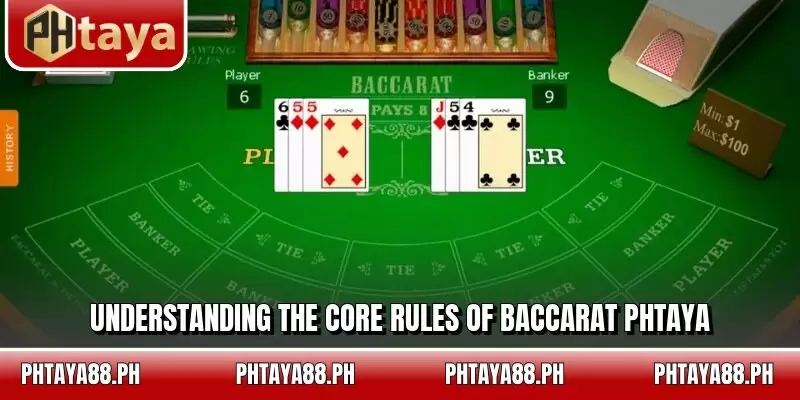
Understanding the core rules of Baccarat PHTAYA
Baccarat is distinct because the players themselves do not make decisions on drawing cards; instead, fixed rules govern whether the Player or Banker hand receives a third card.
This automated drawing mechanism means the player’s only active decision in Baccarat PHTAYA is where to place their chips before the cards are dealt.
The objective and card values
The objective of Baccarat PHTAYA is to predict which of the two hands—the Player or the Banker will have a total card value closest to nine.
- Ace: Counts as 1.
- Cards 2 through 9: Count as the value shown.
- Tens and Face Cards (J, Q, K): Count as 0.
Hand totals are calculated by summing the value of the cards, and only the last digit of the total is used. For example, a hand totaling 15 counts as 5, and a hand totaling 10 counts as 0.
A two-card total of 8 or 9 is called a natural and automatically ends the round with an immediate win unless the opposing hand also holds a natural of equal or greater value.
The third card rules: Player and Banker
The complexity of Baccarat lies entirely in the fixed rules governing the third card draw. The player does not control these draws, which ensures the game maintains its high speed and simplicity.
- The Player’s Hand: The Player hand always acts first. If the Player’s two-card total is 0 through 5, the Player draws a third card. If the total reaches 6 or 7, the Player stands. If the total is 8 or 9 (a natural), both hands stand.
- The Banker’s Hand: The Banker’s action is conditional, depending both on its own two-card total and the value of the third card, if any, drawn by the Player. For instance, if the Banker’s total is 3, the Banker draws a third card unless the Player’s third card was an 8. If the Banker’s total equals 7, the Banker always stands.
This seemingly intricate set of rules is handled entirely by the dealer in Baccarat, allowing the player to focus purely on the financial strategy. The underlying math ensures the Banker hand maintains its slight statistical advantage.
Payouts and the mathematical edge
The payout structure of Baccarat PHTAYA is key to understanding the game’s long-term dynamics. The payouts reflect the true statistical advantage of each hand.
| Bet Type | Payout Odds | House Edge (Multiple Decks) | Payout Feature |
| Banker | 0.95 to 1 (Even Money minus 5% Commission) | 1.06% | Lowest house edge, most frequent winner |
| Player | 1 to 1 (Even Money) | 1.24% | Second-best house edge, simple payout |
| Tie | 8 to 1 | 14.36% | Avoid this bet due to extremely poor odds |
The small commission on Banker wins is precisely what maintains the house edge balance. Without this commission, the Banker bet would hold a mathematical edge over the Player bet with a 0% house advantage, which is unsustainable for the casino.
Accepting the commission as the cost of the best statistical play is central to serious Baccarat PHTAYA strategy.
Mastering card counting techniques in Baccarat PHTAYA
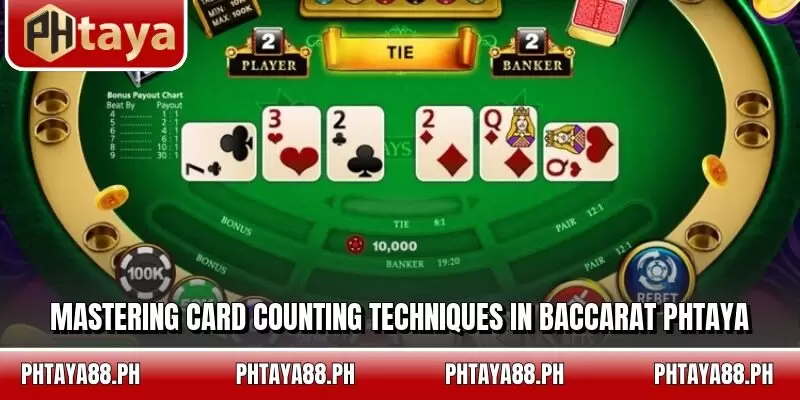
Mastering card counting techniques in Baccarat PHTAYA
Because Baccarat is driven purely by probability, strategy centers on choosing low house-edge bets, maintaining discipline, and managing capital to withstand variance. These approaches help structure wagers so players stay aligned with statistically favorable outcomes while controlling bankroll risk.
The unwavering commitment to the Banker bet
The key strategic choice in Baccarat PHTAYA is consistently betting on the Banker, purely for mathematical reasons. With a 1.06% house edge, it offers better long-term returns than the Player bet at 1.24%, regardless of perceived patterns or streaks.
This approach demands discipline, especially when Player wins cluster together. Experienced players ignore short-term variance, stay committed to the lowest house-edge option, and strictly avoid the Tie bet, whose 14.36% edge can quickly drain a bankroll.
Systematic progression with flat betting
Despite the popularity of systems like Martingale or Fibonacci, the most statistically reliable approach in Baccarat is flat betting on the Banker. By wagering a fixed amount each hand, players avoid escalating losses during unavoidable downswings, a common flaw of aggressive progression systems.
If a progression is used, it must be tightly controlled with clear limits. A safer option is the Paroli system, which increases bets only after wins and resets after losses, allowing players to leverage short winning streaks while reducing the risk of heavy drawdowns.
Understanding and ignoring scorecards (Roads)
Baccarat PHTAYA tables often display scorecards like the Big Road or Bead Road to show past results, but these visuals have no predictive value. Each hand is independent, and the probability remains unchanged regardless of previous outcomes.
Baccarat is not a game of patterns or memory. Relying on these displays to guide bets is the Gambler’s Fallacy, while disciplined play focuses solely on the fixed mathematical house edge, not perceived trends.
Coclusion
Baccarat PHTAYA delivers a statistically favorable experience where success depends on disciplined bet selection and careful bankroll control. By focusing on the Banker bet, using conservative staking, and ignoring false streak patterns, players align with the game’s best odds on a transparent platform.
 Golden And Silver Horn Summon Legendary Treasure Power
  Formosan Birds – Master The Sky And Claim Your Fortune
  Dragon Treasure – Master The Ocean And Dominate At PHTAYA
  Jaw-Dropping Strategies in Tiger Baccarat’s Clever Playbook
  Dragon Treasure – Master The Ocean And Dominate At PHTAYA
  Midnight Terror – Discover The Hidden Wealth In The Dark